 Airman Vision
The platform
Three modules, in detail.
Private AI, Vision and Cyber defense share one software stack and one rule: the models, the data and the audit trail live on hardware the customer owns.
Module 01 · Prototype running
Private AI: the software stack.
A chat workspace that answers questions about the organization's own documents, with every part of it running in the building. What runs today, and the production path for each layer:
| Model serving | Ollama today. NVIDIA NIM on TensorRT LLM in production. |
| Chat workspace | Open WebUI with single sign on, roles and an audit log. |
| Models | Nemotron, Qwen and Gemma, picked per system size. |
| Retrieval | A local document index today. NeMo Retriever for embeddings and reranking. |
| Safety | NeMo Guardrails for topic, PII and jailbreak rails. |
| Data | Encrypted disk, per user access, no outbound traffic. |
Reference systems
Three sizes, set by headcount.
The software is identical on all three. Only the NVIDIA hardware underneath changes.
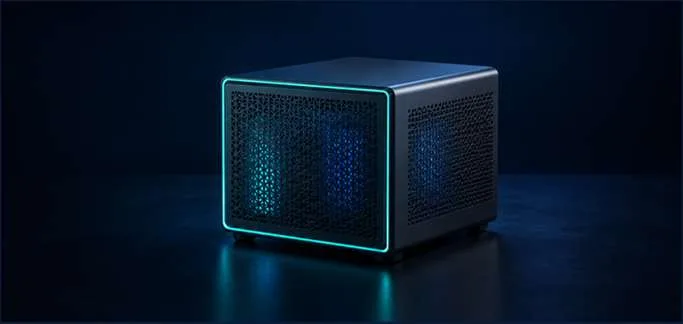
CORE
5 to 10 people
NVIDIA DGX Spark with 128 GB unified memory and a 20 core Arm CPU. Runs models up to about 120B parameters (4 bit mixture of experts) plus vision. 10GbE with a capture port.
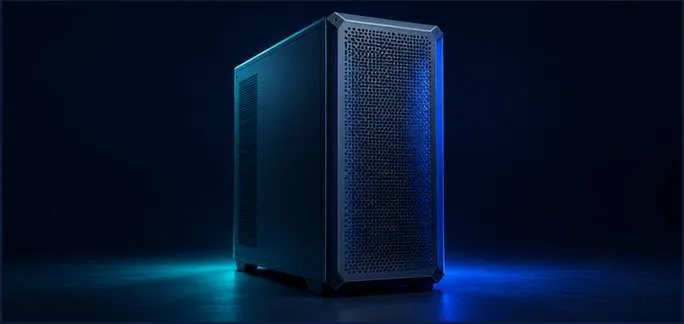
TEAM
About 25 people
RTX PRO 6000 Blackwell Max-Q with 96 GB GDDR7 ECC, Threadripper 9960X and 256 GB RAM. Runs a 70B dense or 120B mixture of experts model with vision. Dual 10GbE with a capture port.
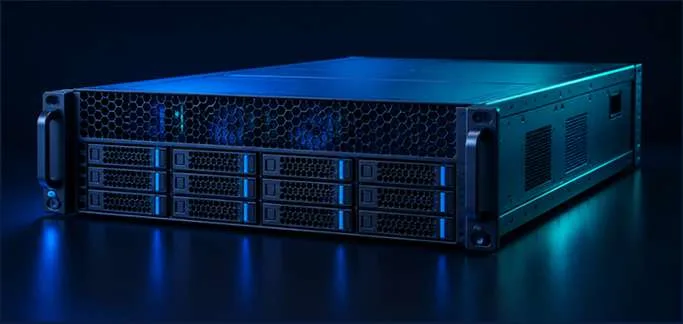
ENTERPRISE
75 plus people and campuses
Two RTX PRO 6000 Blackwell Server GPUs with 192 GB GDDR7 ECC, expandable to four, EPYC 9355 and 512 GB RAM. Several large models at once. Dual 25GbE, capture port and BMC.
Growth path: Core links a second DGX Spark, Team adds a second GPU, Enterprise grows to four GPUs and adds Jetson edge units.
Module 02 · Vision
Detect the events that matter. Then prove they are real.
Detection classes
Firearm, aggressive behavior, falls, loitering, and fire and smoke. One model family, one alert pipeline.
Training and serving
Fine tuned with NVIDIA TAO, optimized with TensorRT, served through Triton and streamed through DeepStream.
Metrics we will publish
Precision, recall, mean average precision, and false alarms per camera per day, all on a held out real test set.
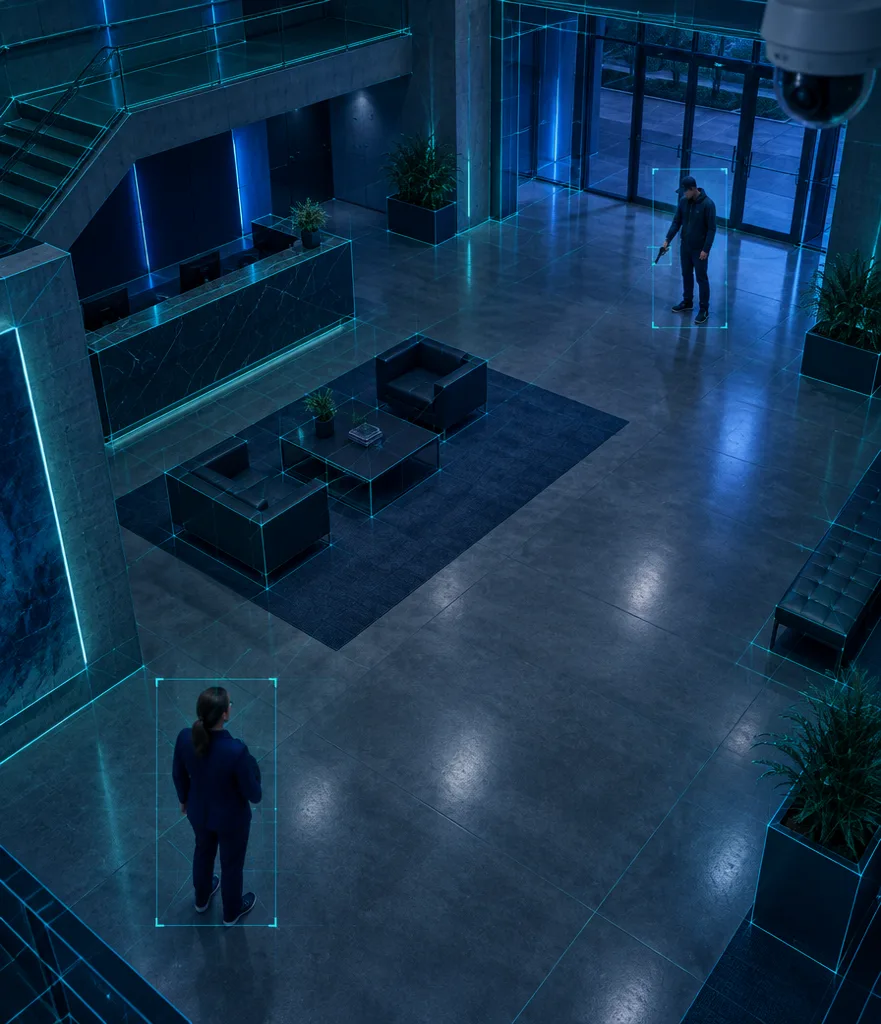
Training data
Synthetic first. Real data to validate.
Real gun footage is rare and legally hard to collect. So we generate it: labeled scenes with varied lighting, angles, occlusion and camera types.
Validation rule
Every model is tested on real footage it never trained on. Synthetic data widens coverage. Real data decides whether we ship.
Why it matters
Labeled, privacy safe training data for rare events is the scarce asset. Each new site adds scenes without exposing a single real video.
Architecture
Detect at the edge. Reason in the core.
Data stays put
Raw video stays on the edge or site box. The upstream link carries alerts, metadata and clips the customer approves.
Open vocabulary detection
A VLM lets operators describe a new threat in plain words and get a detector candidate without retraining first. A demo with open source VLMs is planned.
The second check
Every alert is re read by a vision language model before a human sees it.
Planned
Ask your cameras a question.
Plain English footage search, built on the NVIDIA video search and summarization blueprint. Clips are embedded and captioned locally, then indexed for text queries.

Example queries
“Person in a red jacket near the loading dock after 6 pm.”
“Show every vehicle that stopped at gate 2 last night.”
Summaries
Long footage becomes a short written timeline an investigator can read in a minute.
Stays private
Embeddings, captions and the index live on the site box. Nothing is sent to an outside service.
Module 03 · Planned
Watch the LAN. Map findings to the controls auditors ask about.
Network defense agent
NVIDIA Morpheus reads mirrored traffic on the capture port. Phishing detection and digital fingerprinting flag users and devices that behave out of pattern.
CMMC compliance agent
Findings and logs mapped to CMMC practice families: access control, audit and accountability, incident response, and system and communications protection.
Evidence on demand
The agent assembles a dated evidence pack per control: what was monitored, what fired, what was done.
Honest scope
The software collects and organizes evidence. It does not certify anyone. The assessor does.

Inside Private AI
A local agent that can act, with a human holding the keys.
Prototype today
Ollama and Open WebUI with MCP tools for browser and PC control, running on an RTX 5090 system.
Production design
The agent runs on NIM with NeMo Guardrails: allowed tools, allowed sites, PII rails, and refusal of off policy actions.
Human approval
Any action that changes something pauses for a click from the operator.
Full logging
Every prompt, tool call and result is written to an append only log the customer owns.
All planned
Analytics on GPU, plus two demos that prove the pattern.
Crime Locater
Map and trend analysis of incident data accelerated with RAPIDS cuDF. We will publish GPU versus CPU speedups on the same dataset.
Open source VLM demo
Edge and cloud designs with open vocabulary detection, shown as a public demo of the second check idea.
VLM agent on DGX
A larger VLM agent on a DGX that reviews flagged events and answers investigator questions.